Join the movement to end censorship by Big Tech. StopBitBurning.com needs donations and support.
New study links nighttime coughing to air pollution, even in “clean” cities
By isabelle // 2026-09-18
Mastodon
 Parler
 Gab
Gab Copy
Copy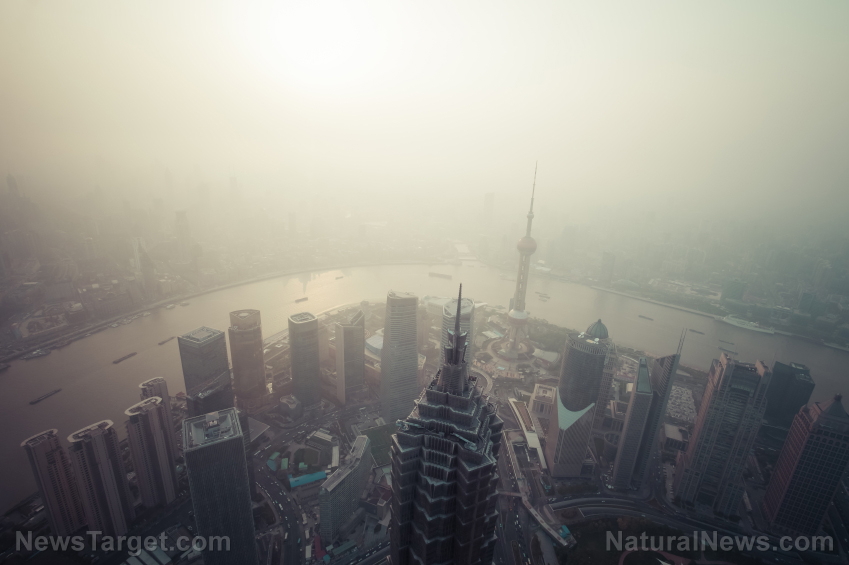
- Nighttime coughing rises 2.4% for every 10-microgram increase in daily air pollution, a new study finds
- The link held even when pollution stayed below WHO safety guidelines, suggesting no exposure level is truly safe
- Researchers tracked cough sounds from tens of thousands of users in 32 cities across 12 countries using the Sleep Cycle app
- The January 2025 Los Angeles wildfires saw nighttime coughing spike nearly 10 percent as PM2.5 levels surged
- Scientists say the findings point to nighttime coughing as an early warning signal for air quality problems
Cough risk climbs even under WHO guidelines
The study found that for every increase of 10 micrograms per cubic meter in daily fine particle pollution, nighttime coughing rose by roughly 2.4% across all cities. Notably, this effect persisted even on days when pollution levels remained below the WHO's recommended 24-hour safe exposure limit. Researchers accounted for confounding factors like seasonal flu, which normally drives up cough rates. "I was surprised we could still see the signal at all," said lead author Tong Xia. "I thought that adding in the confounding factor of flu season would make the link in the data disappear, but it didn't." The pattern held in 23 of the 32 cities after controlling for influenza activity. Crucially, the data showed no safe floor: cough risk continued to decline as pollution dropped toward near-zero levels, suggesting that current guidelines may not adequately protect respiratory health.Wildfire smoke drives sharper cough spike in Los Angeles
The January 2025 wildfires near Los Angeles provided a real-world test of the pollution-cough link, with the region acting as a quasi-natural experiment. During the fires, PM2.5 readings climbed by more than 8 micrograms per cubic meter, and cough counts tracked the increase closely. Within that period, a 10-microgram pollution increase was associated with nearly a 10% rise in coughing, which is roughly quadruple the everyday effect. While researchers noted that coughing had ticked up slightly before the sharpest pollution rise, and the post-fire jump narrowly missed statistical significance, they described the wildfire data as supportive evidence consistent with the broader global pattern.Sleep app turns phones into public health sensors
The research relied on the Sleep Cycle app's AI algorithm, which analyzes nighttime sounds recorded locally on users' phones with over 90% accuracy. "Every night, Sleep Cycle's technology turns millions of smartphones into precise sound analysis instruments," said co-author Dr. Mikael Kågebäck of Sleep Cycle AB. Audio data never leaves individual devices, preserving user privacy while providing an unprecedented public health dataset. The privacy-first design gave researchers an advantage over traditional studies, which are often limited to hospital data from a single country. "Most public health studies only have data from one country, so having a dataset of this size gives it much more power," said senior author Cecilia Mascolo.Cough signals may offer real-time pollution warning
The study suggests that nighttime coughing could serve as an early warning signal for air quality problems, catching airway irritation long before it might otherwise be noticed. Researchers are careful to note that the study is purely observational and does not prove causation. "This suggests that there may be no such thing as a safe threshold for exposure to air pollution, although our research is purely observational," Mascolo said. She added that people concerned about their exposure may consider using masks or air filters. For readers wary of relying on government thresholds to protect their health, the study's core finding will sound familiar: an official safety line doesn't necessarily mean the air below it is harmless. With no floor at which pollution stops affecting the lungs, the more practical takeaway may be for individuals to track their own exposure and act on it — air filtration, masks during smoke events — rather than waiting on regulators to catch up to what the data already shows. Sources for this article include: StudyFinds.com Cam.ac.uk USNews.comMastodon
Parler
Gab
Copy
Tagged Under:
sleep glitch toxins research allergies Air pollution air quality clean air badhealth badpollution health science coughing
You Might Also Like

Oracle’s Force Majeure Reveals the AI Bubble’s First Real Crack
By Mike Adams // Share

First U.S. Trial Against TikTok to Test Claims Platform Fueled Teen Mental Health Harms
By Edison Reed // Share
Study Finds Scented Products Raise Indoor Air Pollution Levels
By Iva Greene // Share
Study: Stroke Rates Nearly Doubled in Adults Under 55
By Morgan S. Verity // Share

Anthropic CEO Amodei: Poorly Managed AI Could Pose “Risk to Humanity”
By Chase Codewell // Share

Australian PM: OpenAI Agent Accessed Country’s Medicare Portal
By Edison Reed // Share
Recent News



Popular This Week